A reindeer farm visit takes you past the Christmas-card version of Lapland. You feed reindeer from your hand, sit behind one on a slow sleigh ride through the snow and, on the better visits, spend time with the people who look after the herd all year.
Farm visits vary much more than the booking pages suggest. Some tours near Rovaniemi are polished family activities lasting an hour or two. Others take you to a working family farm, where the part you remember is sitting by the fire while a herder explains what happens to the animals once the visitors have gone home.
One distinction matters before you book: reindeer herding in Finland is not exclusively Sámi, and not every farm in Lapland offers a Sámi cultural experience. If Sámi culture is what interests you, look for a Sámi-owned or Sámi-hosted visit, mainly around Inari, Utsjoki, Enontekiö and northern Sodankylä.
Quick take: For a first visit, book a small-group farm visit of about 1.5–3 hours that includes feeding, time with a working herder and, in winter, a sleigh ride of at least several hundred metres. If Sámi culture is a main reason for your trip, choose an explicitly Sámi-hosted experience. If the ride itself matters most, our guide to reindeer sleigh rides in Lapland compares ride lengths, prices and which tour to book.
Reindeer farm visits in Lapland at a glance
| Question | What to know |
|---|---|
| Best season | December to March for snow and sleigh rides |
| Can you visit in summer? | Yes, some farms open all year |
| Typical duration | About 1.5–3 hours |
| Typical starting price | About €46–€100 per adult through local operators; €87–€199 for GetYourGuide tours with transfers from Rovaniemi |
| Good for children? | Usually very good |
| Can you feed reindeer? | Usually included |
| Is a sleigh ride always included? | No, and the distance varies from about 400 metres to 3 km |
| Easiest places to visit a farm | Rovaniemi, Levi, Saariselkä and Inari, Kilpisjärvi |
| Do all farms offer Sámi experiences? | No |
| Do you need to book ahead? | Yes from December to March |
| Warm clothing provided? | Sometimes on organised tours; check the listing |
Prices and inclusions vary by operator and season. On Visit Finland in October 2026, a Sámi family farm visit near Inari is listed from €46 (Visit Finland) and a two-hour Rovaniemi farm visit with transfers and winter clothing from €69 (Visit Finland). Tours sold on GetYourGuide from Rovaniemi usually cost more because they bundle transfers, clothing and a longer ride, so check the dates you want before comparing.
What happens on a reindeer farm visit
There is no standard Lapland reindeer experience. A visit can be anything from a short stop at a tourist enclosure to several hours with a herding family. The better tours combine several of the following.
Meeting and feeding the reindeer
This is the easiest way to get close to them. Reindeer used to visitors walk up to the feeding area with surprising confidence, especially once food appears. Depending on the farm, you feed them lichen or another feed the herder hands you.
Younger children usually love this part, because they get to do far more than look at animals behind a fence. Don’t bring your own food; feed only what the farm provides.
Learning how reindeer herding works
This is the part to prioritise when two tours look alike. Finnish reindeer are not kept in a small enclosure all their lives. They graze across huge areas, and herders manage them through a seasonal cycle.
Finland’s legally defined reindeer husbandry area covers 122,936 square kilometres, about 36% of the country (Reindeer Herders’ Association), and it is divided into 54 herding cooperatives (paliskunnat.fi). Around 4,400 people own reindeer in Finland, and one person may own at most 500 (Reindeer 2020, Reindeer Herders’ Association).
The herder’s work changes through the year. Calves are born mainly in May and June. Summer vegetation lets the reindeer gain weight and grow new antlers; in winter they dig for food beneath the snow (paliskunnat.fi). A good host can turn what looks like a simple animal encounter into one of the more interesting cultural visits in Lapland.
Taking a reindeer sleigh ride
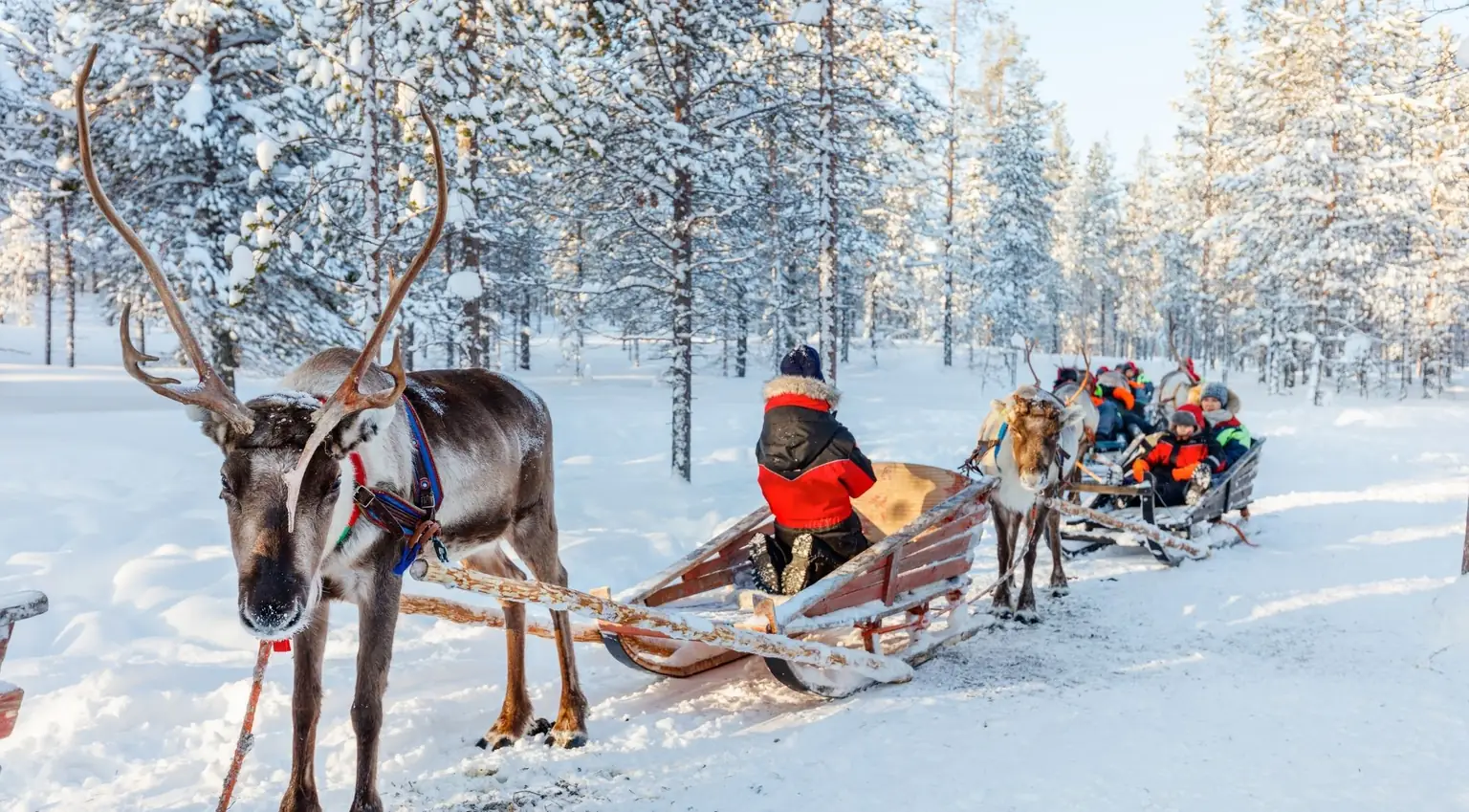
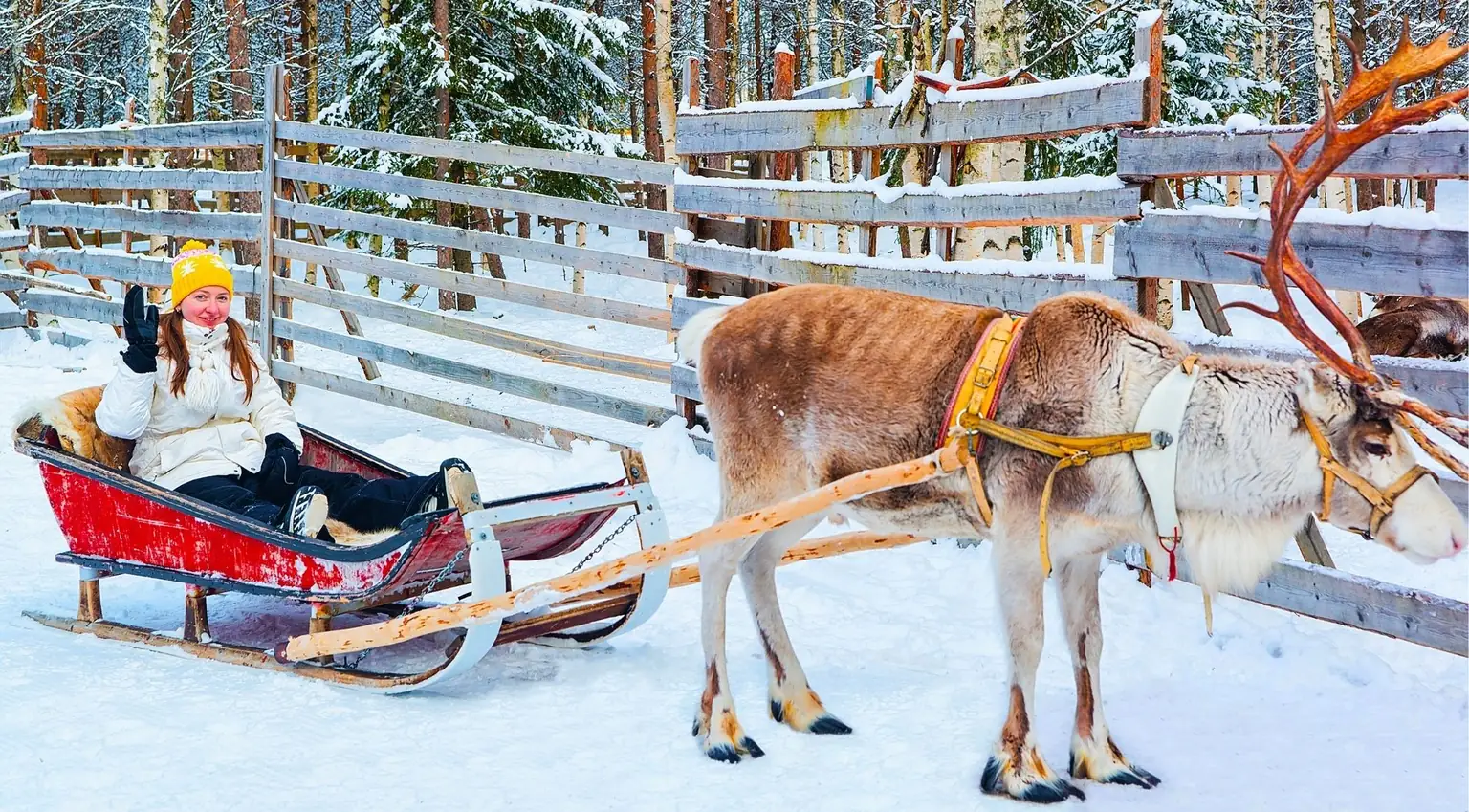
This is what many visitors picture: blankets around your legs, snowy forest and a reindeer ahead walking at an unhurried pace. A reindeer sleigh is not the adrenaline ride that husky sledding or snowmobiling can be. It is quiet and slow, which is why many people enjoy it.
Advertised “reindeer rides” differ a lot in length. Current GetYourGuide listings around Lapland show the range:
- about 400 metres on the Rovaniemi: Authentic Reindeer Farm Visit & Short Sleigh Ride (from €150, 4.7/5 from 416 reviews);
- 500 metres on the Rovaniemi: Reindeer Experience with Sleigh Ride (from €87, 4.2/5 from 1,585 reviews);
- about 1 km on the Levi: Reindeer Sleigh Ride Tour in Snowy Forest (from €141, 4.4/5 from 224 reviews);
- 2–2.5 km, about 40 minutes, on the Rovaniemi: 2km Reindeer Sled Ride Through the Forest (from €179, 4.8/5 from 275 reviews).
What to check before booking
Don’t judge a tour by its photographs; look for the stated distance. A 200–400 metre loop can be over almost as soon as you have settled into the sleigh. That is fine if the farm visit is your priority, but it can disappoint someone booking mainly for the ride. For a more substantial ride, look for about 1 km or longer.
Is a reindeer farm worth visiting?
On a first trip to Finnish Lapland, yes, especially if you have never been close to reindeer before. Choose carefully, though. The best farm visits give you animals, landscape and a glimpse of local working life at once. A poor one feels like a ten-minute animal encounter padded out into a tour.
A farm visit suits you if you
- are travelling with children;
- want a quieter alternative to snowmobiling;
- are interested in northern culture and livelihoods;
- want close-up reindeer photographs;
- need an activity that works for several generations;
- want something that belongs to Lapland and nowhere else.
You may be disappointed if you
- expect the speed of dog sledding;
- book an expensive tour without checking how short the sleigh ride is;
- expect every “traditional Lapland” activity to be Sámi;
- mainly want to see reindeer and already have several good wildlife encounters planned.
Reindeer farm or reindeer sleigh ride?
The two overlap but are not the same booking. A farm-focused tour puts more weight on feeding, talking to the herder and learning about the animals; a sleigh-focused tour puts you in the sled for longer. Our reindeer sleigh ride guide sets the two side by side with the full price ladder. For most first-time visitors, the best choice combines both: a working farm, feeding, a conversation with the herder, a winter ride of about 1 km and a hot drink.
Reindeer farms around Rovaniemi
Rovaniemi has the largest choice of easily bookable reindeer experiences and is the obvious base if you are staying in the city. Most farms used by tours are about 20–35 minutes’ drive from the centre, and the tours collect you from town.
The Wonderlapland farm visit with a short sleigh ride is our pick for a farm-focused visit. It goes to what the operator describes as the oldest traditional reindeer farm in Rovaniemi, includes feeding or watching the herders feed the animals, a 400-metre ride when snow allows, and a long question-and-answer session with the herder around the fire in a kota with hot berry juice. It costs from €150 for about 2.5 hours (4.7/5 from 416 reviews). The listing does not include winter clothing, so dress for standing outside.
If you would rather drive farther for a quieter, private visit, Unari Lake Reindeer Farm sits about 90 km north of Rovaniemi and runs a private farm visit with a walk alongside the reindeer, from €130 (5.0/5 from 43 reviews, a smaller sample). Through local operators, Lapland Welcome’s two-hour farm visit with transfers, winter clothing, feeding and lasso throwing is listed from €69 (Visit Finland).
Why choose Rovaniemi?
The big advantage is convenience. You can combine a reindeer visit with:
- Santa Claus Village;
- husky sledding;
- Northern Lights tours;
- snowmobiling;
- the Arctic Circle line itself.
There are also many combination tours that fit Santa, huskies and reindeer into one day, such as the Rovaniemi: Reindeer, Huskies & Santa Claus Village (from €188, 4.6/5 from 2,418 reviews), which includes a 500-metre reindeer ride.
The downside
Convenience can cost depth. Some packages move you quickly between several attractions. They help when your itinerary is short, but if the farm itself interests you, a dedicated small-group visit is usually the better booking.
Reindeer farms in Levi
Levi also has good access to working farms and winter sleigh rides, so you don’t need to travel to Rovaniemi for a good reindeer visit. Levi makes particular sense if your holiday is already a ski trip.
Sammun Tupa, a family-owned farm near Levi, runs a two-hour visit with feeding, a 1 km sleigh ride, a tour of the old farm and its home museum, and hot drinks with a home-baked pastry, listed from €79 through Polar Star Travel (Visit Finland). On GetYourGuide, the Sami Spirit: Reindeer Ride with a Sami Herder pairs an 800-metre ride with a Sámi herder and a husky kennel visit for about an hour, from €89 (4.7/5 from 38 reviews, a small sample).
Reindeer farms around Inari and Saariselkä
If your priority is Sámi culture, look closely at Inari and the surrounding north. This is where a reindeer visit can become much more than an animal attraction.
Near Lemmenjoki, a Sámi reindeer-herding family hosts a 1.5-hour visit that combines feeding the reindeer with talk about modern herding, Sámi culture, traditional clothing and felt craft, listed from €46 between December and April (Visit Finland). It is not sold on GetYourGuide; book it through the operator.
On GetYourGuide, Reindeer feeding in Inari takes you to a local farm near Inari village, by snowmobile sleigh when conditions allow, to feed the reindeer lichen from your hand, from €125 (4.9/5 from only 9 reviews, so treat the score with caution).
Inari also lets you combine the visit with:
- the Sámi Museum Siida;
- Lake Inari;
- Northern Lights excursions;
- wilderness activities;
- other Sámi-owned cultural experiences.
If you are interested in Indigenous culture and not only a photograph with a reindeer, this part of Lapland deserves serious consideration.
Kilpisjärvi
Kilpisjärvi, in far north-western Finland, is another strong option for a deeper cultural visit. One listed experience introduces you to a Sámi herder whose family has herded reindeer around Kilpisjärvi for generations, with feeding, the annual herding cycle, clothing and Sámi customs (Visit Finland). Another family runs a year-round visit that combines reindeer with storytelling about herding and Sámi culture (Visit Finland). Neither is sold on GetYourGuide.
The drawback is geography: Kilpisjärvi is a long way from Rovaniemi and hard to fit into a short city-based holiday.
Reindeer herding and Sámi culture
This is one of the most misunderstood parts of Lapland tourism.
Not every reindeer herder is Sámi
Reindeer herding is central to Sámi culture, particularly in northern Finland. But Finnish reindeer husbandry is not practised only by Sámi people. The Sámi began herding reindeer in the late Middle Ages, and Finnish settlers also took up herding early on and developed it for their own needs (Reindeer 2020, Reindeer Herders’ Association). Today the herding area reaches much farther south than the Sámi Homeland.
So a reindeer farm is not automatically a Sámi reindeer farm, and Lapland culture is not automatically Sámi culture.
Where is the Sámi Homeland in Finland?
According to the Sámi Parliament, Finland’s Sámi Homeland covers:
- Utsjoki, Inari and Enontekiö in full;
- the northern part of Sodankylä, around Vuotso.
It does not include Rovaniemi or Levi (Sámi Parliament). You can still meet Sámi people and Sámi-led businesses elsewhere. Just don’t assume that a Rovaniemi tour branded with phrases like “Lappish tradition” or “Arctic shamanism” represents Sámi culture.
How to find an authentic Sámi reindeer experience
If you want to learn about Sámi culture, look for:
- Sámi-owned or Sámi family in the description;
- a Sámi reindeer herder as your host;
- a named host or family;
- a clear connection between the operator and the community being presented.
Be more cautious when the marketing only offers:
- “Sámi-style” or “traditional Lappish”;
- costumes with no explanation;
- generic “shaman” ceremonies;
- vague Indigenous imagery without saying who hosts the experience.
The Sámi Parliament of Finland has published ethical guidelines for Sámi tourism because Sámi symbols and traditions have been used by outside businesses in misleading or exploitative ways. Their core principle is that tourism presenting Sámi culture should rest on a strong connection with, and responsibility towards, the Sámi community concerned (Sámi Parliament).
That gives you a simple rule: if a tour sells Sámi culture, find out who is telling the story.
What reindeer herding is like through the year
The tourist visit is a small part of the herder’s year. Finnish reindeer are managed by herding cooperatives and graze across large landscapes; most do not spend their lives inside fenced farms. The work follows the seasons.
Spring
Calving takes place mainly in May and June.
Summer
Plants and mushrooms are plentiful, the reindeer gain weight and new antlers grow.
Autumn
Gathering, round-ups and separation work dominate, and the rut begins.
Winter
Reindeer are well adapted to Arctic conditions and dig through snow for lichen. Supplementary feeding differs between regions and farms (paliskunnat.fi).
Ask your host about this cycle. You will learn far more than from an information board.
Can you see reindeer without visiting a farm?
Yes. Reindeer roam across Finnish Lapland, and Visit Finland notes that you commonly see them in forests, on the fells and beside roads (Visit Finland).
A roadside reindeer is a wildlife sighting. A good farm visit gives you:
- close interaction;
- supervised feeding;
- detailed photographs;
- the chance to ask questions;
- an understanding of herding.
Never approach or feed free-ranging reindeer unless a herder tells you to. If you are driving, slow down when you see reindeer near the road: they can step out without warning.
Visiting a reindeer farm in winter
December to March is the classic season. This is when you are most likely to get the scene you imagine: deep snow, steaming breath, snowy spruce and sleigh runners on packed trails.
December adds the Christmas atmosphere but also brings:
- the largest crowds;
- high accommodation prices;
- short daylight hours;
- heavy demand for tours.
January and February are reliably wintry without the Christmas rush. March is underrated: there is far more daylight and the landscape is usually still snowy. Our guide to Lapland in winter covers the months in more detail.
Can you visit reindeer farms in summer?
Yes, and many Lapland guides overlook it. Some farms around Rovaniemi and in northern Lapland, including year-round family visits around Enontekiö and Kilpisjärvi, welcome visitors all year (Visit Finland).
You won’t get a snow sleigh ride. Summer suits you if you care more about the animals and herding than the Christmas atmosphere, and a visit outside peak season can feel less staged.
Best time of day for a farm visit
In midwinter, morning and afternoon work differently from home. Around December daylight is short, so if photography matters, book a visit that overlaps with the brightest part of the day. The blue twilight around sunrise and sunset can be beautiful, but a late-afternoon tour may take place almost entirely in darkness. By February, and especially March, timing is much easier.
How cold is the experience?
You stand outside for longer than many people expect. A mild winter day may sit just below freezing; cold spells drop below -20°C and sometimes much lower. A sleigh ride feels colder than walking because you are sitting still, so your boots, gloves and layers matter more here than on an active snowshoe walk.
What to wear
- thermal base layer;
- fleece or insulating mid-layer;
- insulated winter jacket;
- thermal leggings or trousers;
- proper winter boots;
- warm wool socks;
- insulated mittens or gloves;
- hat that covers your ears;
- neck warmer.
Many organised excursions provide thermal overalls and boots, particularly longer safari-style tours. Never assume they are included; check the listing. Our Lapland winter packing list has the full kit.
Reindeer farms with children
This is one of Lapland’s easier activities for families. There is usually:
- little physical effort;
- no animal for you to control;
- plenty to look at;
- direct interaction through feeding;
- a warm indoor break on many tours.
Toddlers can often take part, although minimum ages vary. More family ideas are in our guide to Rovaniemi with kids.
With very young children
Check:
- how long you will be outdoors;
- whether thermal clothing comes in children’s sizes;
- whether the sleigh takes small children safely;
- whether transfers need your own child seat;
- whether there is a heated indoor space.
Cold is usually the main concern.
Older travellers and limited mobility
A farm visit is usually easier than husky driving, snowmobiling or snowshoeing, but accessibility varies a lot, and snow itself makes things harder. Ask the operator about:
- the distance from the vehicle to the farm;
- icy paths;
- steps into cabins;
- the height of the sleighs;
- wheelchair access;
- accessible toilets.
Ask directly; “family friendly” does not mean accessible.
How much does a reindeer farm visit cost?
Prices depend on what is included. Through local operators listed on Visit Finland in October 2026, a 1.5-hour Sámi family farm visit near Inari starts at €46, a two-hour Rovaniemi farm visit with transfers and clothing at €69, and the 1 km Sammun Tupa ride near Levi at €79. Farm tours with transfers from Rovaniemi on GetYourGuide cost about €87–€199, depending mainly on the ride length.
Some family farms charge a minimum group fee instead of a simple per-person rate, and Christmas-week dates, private tours and transfers push costs higher. The full ladder, from a €35 park ride to €1,050 private visits, is in our reindeer sleigh ride price guide.
What should be included?
For a standard paid excursion, expect some combination of:
- transport from town or a meeting point;
- farm admission;
- an English-speaking guide or host;
- reindeer feeding;
- an explanation of reindeer husbandry;
- a sleigh ride in winter;
- hot berry juice, tea or coffee;
- a biscuit or pastry;
- thermal clothing on some safari-style tours.
Always read the “included” section. A €60 self-drive farm visit and a €100 excursion with hotel transfers, winter gear and a longer ride are different products, so compare what each includes.
How long should you spend at a reindeer farm?
About two hours suits most visitors. Less than an hour can feel rushed. Three hours makes sense when the price includes transport, a longer sleigh ride, lunch or a cultural programme. Don’t automatically pick the longest tour; pick the one whose itinerary has the most time with the animals and the herder.
Short visit vs half-day tour
| Choose this | Best for |
|---|---|
| 60–90 minutes | Young children, tight itineraries |
| 1.5–2.5 hours | The best balance for most visitors |
| 3–5 hours | A deeper cultural or wilderness day |
| Santa + husky + reindeer combination | First-time families with only a few days |
| Dedicated Sámi-hosted visit | Culture-focused travellers |
Reindeer farm vs husky safari
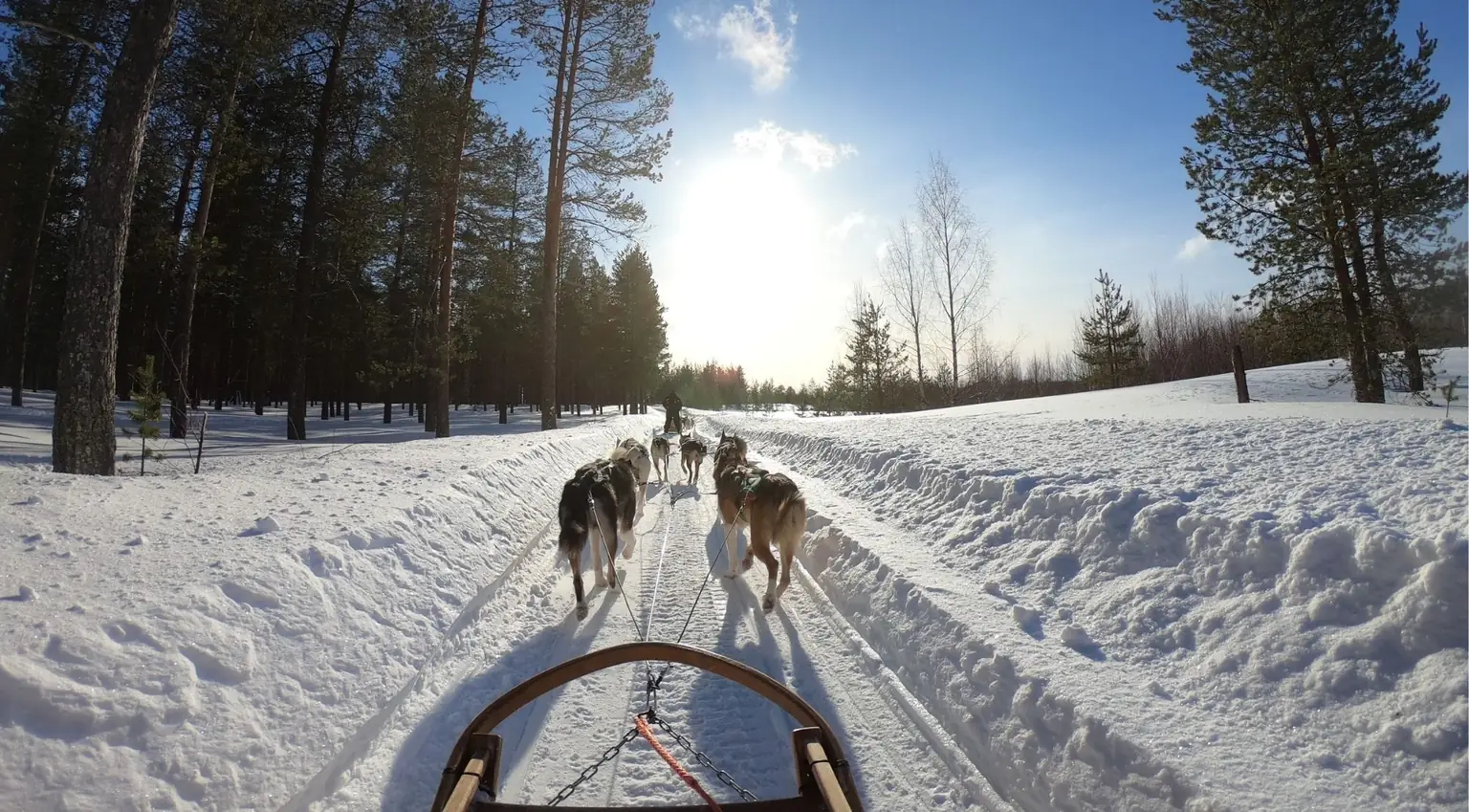
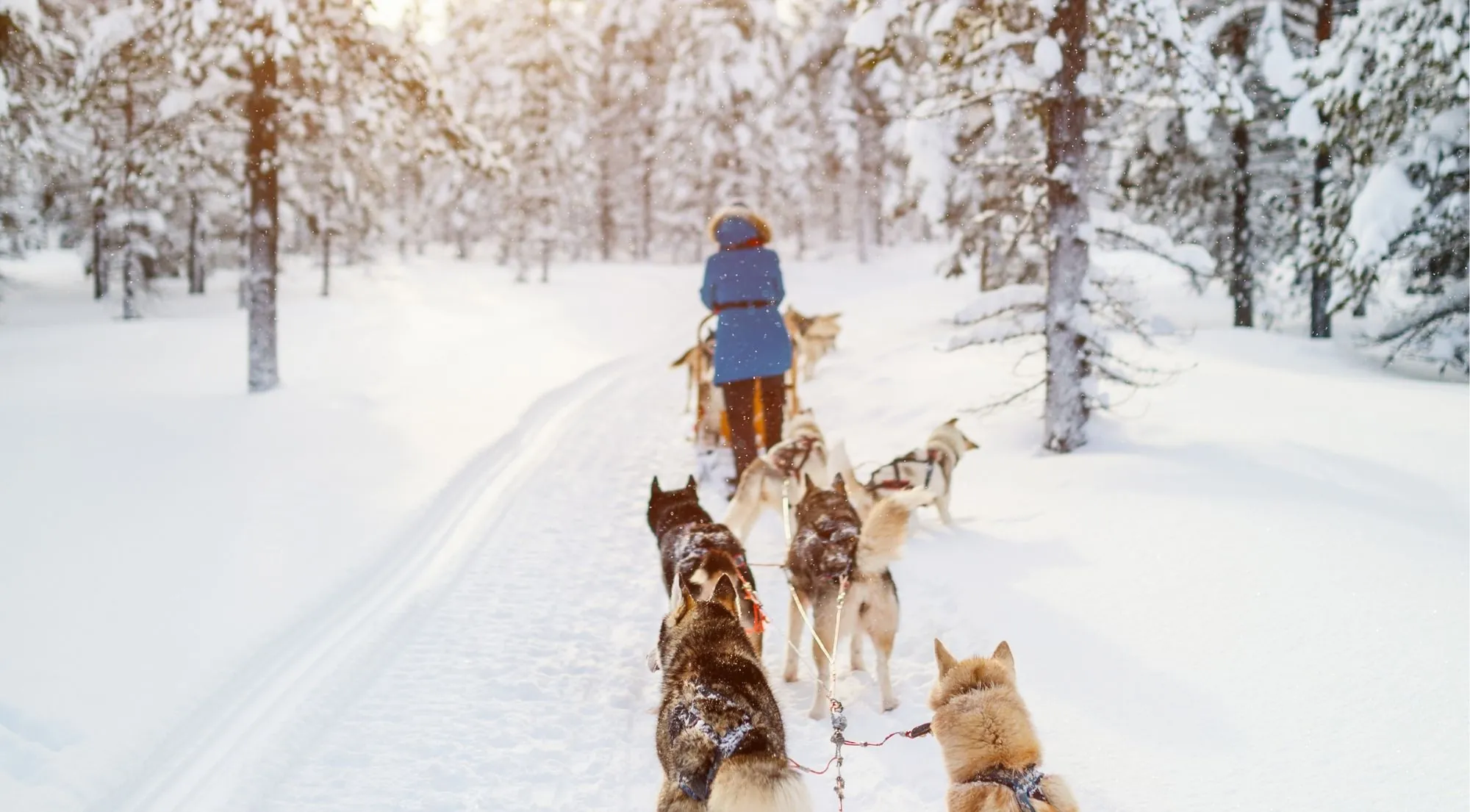
If you only have time for one, know that they are very different. A reindeer visit is quiet and slow, with animals, culture and forest. A husky safari is speed, noise and teamwork. Reindeer visits suit multi-generational families and people interested in Lapland culture; husky tours give you more of an adventure. If your budget allows, book both, because they show different sides of a winter trip. Our husky vs reindeer comparison goes through the differences, and husky sledding in Lapland covers the dogs.
Reindeer farm vs Santa Claus Village
Santa Claus Village has reindeer attractions, but seeing reindeer there is not the same as visiting a working farm. For convenience the village is hard to beat; for learning how reindeer husbandry works, choose a dedicated farm. You can easily do both on a Rovaniemi stay, and our Santa Claus Village visitor guide covers the village side.
Reindeer farm vs seeing reindeer in the wild
A free-ranging reindeer crossing a snowy road is spontaneous; a farm is informative and interactive. If you are driving through Lapland you have a good chance of seeing reindeer for free. That doesn’t make the farm pointless: you pay for access to the herder as well as the animal.
How to choose a good reindeer farm tour
Look for
- A named farm or family. Better than an anonymous “traditional reindeer experience”.
- A working herder as part of the visit. Someone who can explain the job, not a guide reciting facts.
- Small groups. Conversation is much easier.
- A stated sleigh distance. Not just “reindeer ride included”.
- Plenty of time at the farm. Especially when you are transported from Rovaniemi.
- Clear cultural credentials. If Sámi culture is advertised, check whether the experience is Sámi-owned or Sámi-led.
Be cautious about
- vague “authentic Arctic ceremony” language;
- very large coach groups;
- tours where most of your time goes on transfers;
- 100–200 metre sleigh loops presented as major rides;
- cultural costumes used without explanation;
- packages that squeeze five attractions into half a day.
Is feeding reindeer ethical?
Feeding under a farm’s supervision is a normal part of many visits. The herder controls what you feed, how much and where. Don’t feed free-ranging reindeer yourself.
Animal welfare is harder to judge from a booking page, so look for farms that explain the animals’ place in a working herd and don’t treat them only as photo props. You can also look for the Sustainable Travel Finland label, which Visit Finland highlights in its advice on seeing reindeer (Visit Finland).
Can you touch the reindeer?
Sometimes, but don’t assume you should. Reindeer are not petting-zoo animals. Some are used to people and tolerate close contact; others don’t. Follow the herder’s instructions, never grab the antlers, face, fur or harness, and give an animal room to move away.
Do female reindeer have antlers?
Yes, and it surprises many visitors. Unlike most deer, both male and female reindeer grow antlers. The cycle differs between sexes and individuals, so the reindeer you meet may have large antlers, small ones or none, depending on the time of year. An animal without antlers is not necessarily female, and one with big antlers is not necessarily male.
Can you see baby reindeer?
Calves are usually born in May and June, so late spring and summer are the calf season (paliskunnat.fi). Newborn animals are not tourist props, though, and whether you can see calves depends on how the farm manages its herd and its visitors.
Photography tips
Reindeer are photogenic, but winter light in Lapland is difficult.
With a phone
Your phone will often turn snow grey. Tap the reindeer to focus and raise the exposure slightly. Keep the phone inside your jacket between shots in hard frost, because batteries drain faster in the cold.
With a camera
A mid-range zoom of about 24–70 mm works well for feeding and farm scenes; a longer lens lets you photograph individual animals without crowding them. Use a fairly fast shutter speed even when a reindeer seems still, because its head moves constantly.
The best photographs
Don’t spend the whole visit chasing a posed portrait. Better images often include:
- reindeer disappearing between trees;
- steam from their breath;
- a herder feeding the herd;
- antlers against falling snow;
- your sleigh on a forest trail.
Reindeer “driving licences”
Many Lapland farms hand out a playful reindeer driving licence after a sleigh ride. It is a souvenir, not a qualification, and children usually love it.
Should you book in advance?
December
Yes. Christmas and New Year are peak season, and popular farm tours sell out.
January to March
Still book ahead, particularly if:
- your trip is short;
- you want a specific small farm;
- you need a particular language;
- you want a private tour.
Summer and autumn
Availability can be tighter because fewer programmes run daily. Contact smaller farms ahead instead of turning up.
What happens if there isn’t enough snow?
Farm visits usually still go ahead; sleigh rides are another matter. Operators may change the route, replace the ride with another activity, cancel the sleigh part or run the visit differently. This is mainly an issue in early winter and warm spells, and some listings, including the Wonderlapland visit, say the ride is not guaranteed. If the ride is your main reason for booking, read the cancellation and substitution policy.
Can reindeer tours run in extreme cold?
Usually, yes, within limits. Lapland tourism carries on at temperatures that would close attractions elsewhere, but operators shorten, change or cancel an activity when conditions become unsafe. At -25°C a tour usually runs; you just need to dress very well.
Frequently asked questions
Where is the best place to visit a reindeer farm in Lapland?
For convenience, Rovaniemi and Levi. If Sámi reindeer-herding culture is your main interest, Inari, Enontekiö and Kilpisjärvi, and the rest of the Sámi Homeland are the better choice.
Can you visit a reindeer farm from Rovaniemi?
Yes. Several working farms are about 20–35 minutes’ drive from the centre, and most tours include transfers.
How much does a reindeer farm visit cost in Lapland?
Local operators list basic visits from about €46–€80 per adult; tours with transfers, longer sleigh rides or several activities cost €87–€199 on GetYourGuide.
Can you feed reindeer?
Yes. Supervised feeding is one of the most common parts of a farm visit.
Can you ride a reindeer?
You normally ride in a sleigh pulled by a reindeer, not on the animal.
How long are reindeer sleigh rides?
From about 400 metres to 3 km. Check the listed distance before booking; our sleigh ride guide compares them.
Are reindeer farms open all year?
Some are. Others run visitor programmes mainly in the snowy months, roughly from November or December to March or April.
Is reindeer sledding fast?
No. Reindeer sleigh rides are slow and peaceful.
Is a reindeer farm good for toddlers?
Usually, yes. The main challenge is keeping very young children warm during long spells outside.
Are all reindeer farms Sámi?
No. Reindeer herding in Finland is practised by both Sámi and non-Sámi herders.
Is Rovaniemi in the Sámi Homeland?
No. Finland’s Sámi Homeland lies farther north and covers Utsjoki, Inari, Enontekiö and northern Sodankylä (Sámi Parliament).
Which reindeer experience to book
For most first-time visitors, book a 1.5–3 hour small-group visit to a working farm with feeding, plenty of time with the herder, a winter sleigh ride and hot drinks afterwards. That gives you enough time to understand why reindeer matter here without turning it into an exhausting half-day.
If Sámi culture is one of the main reasons you are travelling north, choose differently: book an explicitly Sámi-owned or Sámi-hosted visit around Inari, Utsjoki, Enontekiö and Kilpisjärvi or northern Sodankylä, because a generic “Lappish” farm near Rovaniemi is not the same thing.
If you are travelling with small children and mainly want snow, antlers and a sleigh, keep it simple. A friendly farm near Rovaniemi with a short transfer, feeding and a snowy ride may be all you need. Browse the options on our reindeer tours page, and check your dates early, because December tours sell out.