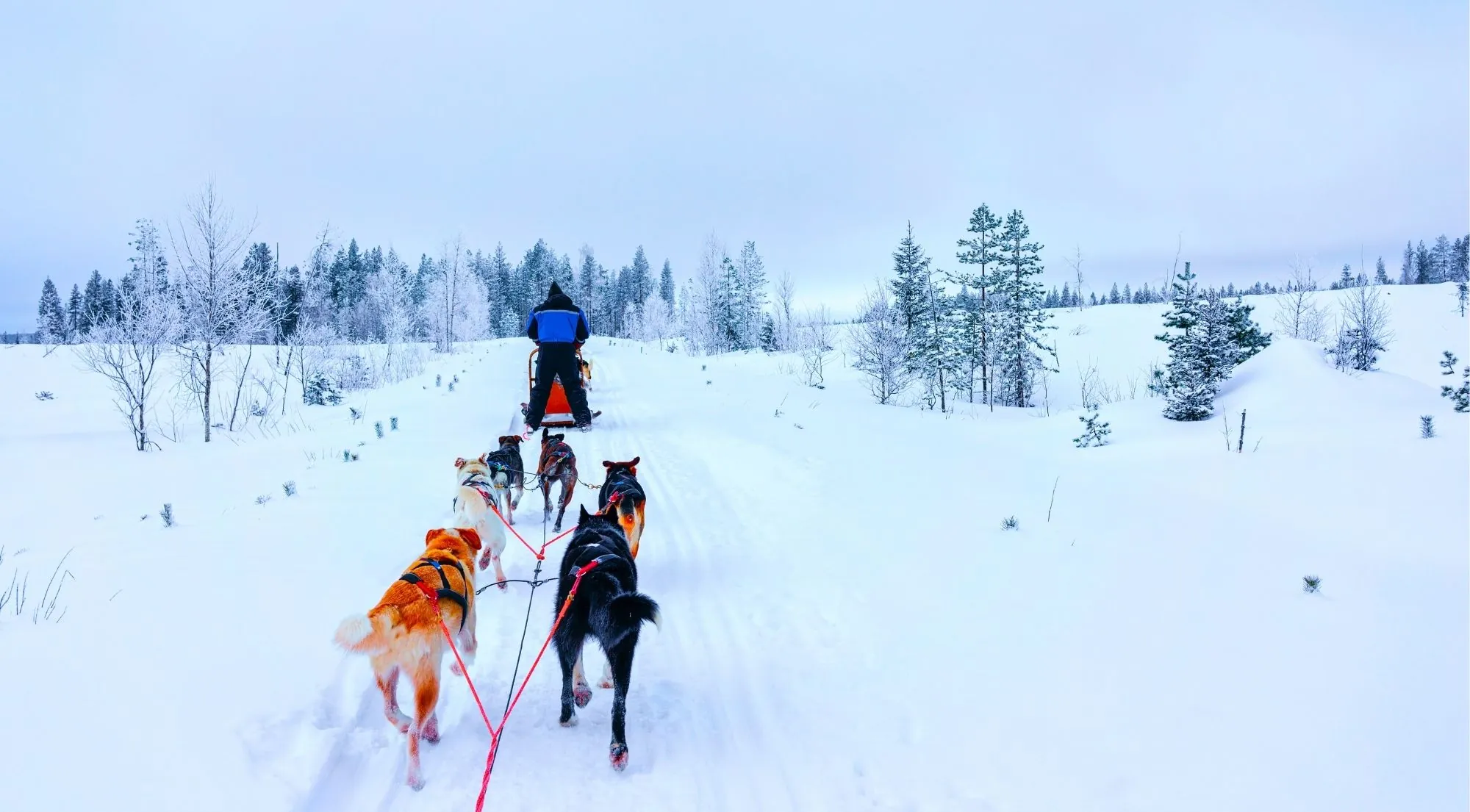
On a good husky safari there is a moment when the barking stops. The sled starts moving, the kennel drops behind you, and all you hear is the runners on the snow and the dogs’ paws working along the trail.
Husky sledding is one of the best winter experiences in Finnish Lapland, but the ride itself can last anywhere from 10 minutes to several hours. Before you book, check the sled distance, whether you drive the team yourself, and how much of the advertised time goes on the transfer to the kennel. On a first trip, look for a 5–10 km self-drive safari: it is long enough to feel like a journey through the forest and short enough that you are not out in the cold for half the day. If you are staying in Rovaniemi and want operators and prices side by side, our Rovaniemi husky tours compared guide lists them.
Husky sledding in Lapland at a glance
| Question | What to know |
|---|---|
| Best first safari | 5–10 km, driving the sled yourself |
| Best for small children | A short ride where a guide drives |
| Best for adventure | 15 km or more, usually around Levi |
| Typical season | December to April, depending on snow |
| Most reliable snow | January to March |
| Can you drive the sled? | On most safaris of 5 km or more, yes |
| Usual sled setup | One adult drives, one sits in the sled; operators vary |
| Typical price per adult | About €50 for a 500 m ride, €150–€240 for 5–6 km self-drive, around €250 for 12–18 km |
| Do you need experience? | No |
| Winter clothing included? | Usually on organised tours, but check |
| Book ahead? | Yes for Christmas, New Year and February |
The range is wide even within one town. In Rovaniemi, Visit Rovaniemi lists a 5 km self-drive safari with Lapland Royal Adventures from €169 and a 10 km one with Rovaniemi Insider from €209 (Visit Rovaniemi), while Visit Finland lists a three-hour Rovaniemi husky safari with Lapland Welcome from €226, transfer included (Visit Finland). Shorter rides cost less, and private and full-day trips cost more.
Is husky sledding in Lapland worth it?
For most winter visitors, yes, as long as the tour gives you enough time on the sled.
A husky safari feels nothing like a snowmobile trip. There is no engine under you, and once the barking at the start fades, the ride can be very quiet. Depending on where you stay, the trail runs through snowy pine forest, across frozen bogs and lakes, or over open fells.
It is also hands-on. On most proper safaris you do not just sit in a sleigh while a guide does the work. Adults get a safety briefing and then drive the sled themselves, usually with another person sitting in it, and many tours let you swap halfway (Visit Finland).
But “husky safari” covers very different trips. A two-hour activity might contain only 15–30 minutes of sledding; another three-hour safari might give you 10 km behind your own team. That difference matters more than almost anything else when you compare tours.
What is a Lapland husky safari actually like?
1. You arrive at the kennel
Most organised tours start with a transfer from your hotel or a meeting point in town. The kennel can be very noisy when you arrive, because sled dogs get excited when they realise they are about to run. That barking is not what the whole safari sounds like: once the teams leave the yard and settle on the trail, it goes quiet.
2. The guide explains how to drive the sled
You do not need any dog-sledding experience. Before you set off, the guide normally shows you how to:
- stand on the runners
- use the foot brake
- keep your distance from the sled ahead
- help the dogs on uphill stretches
- shift your weight through bends
- stop safely
- react if the sled tips or someone falls off
The sled itself is simple. The dogs provide the power; your job is to control the speed and keep the team moving safely.
3. One person drives and another rides
The usual arrangement:
Driver: stands on the runners at the back of the sled.
Passenger: sits in the sled, wrapped up against the cold.
On many tours adults can switch halfway. Families may have children sitting with an adult, but seating rules depend on the operator, the children’s ages, the trail and the sled. In Ranua, for example, Arctic Borealis Huskies runs shorter safaris where small children ride on the same sled as their parents (Visit Finland).
4. The dogs start running
This is the best part. The first pull can feel surprisingly fast, then the team settles into a rhythm and you move deeper into the landscape. The route depends a lot on where you are. You might travel through:
- dense pine and spruce forest
- open, snow-covered bogs
- frozen lakes
- fell country
- private wilderness trails
At Syöte, Visit Finland describes routes through forest and swampland, sometimes across frozen lakes (Visit Finland). Around Levi, a 15 km route runs on trails in Pallas-Yllästunturi National Park (Visit Finland).
5. You return to the kennel
Longer tours often finish around a fire with hot berry juice, coffee, biscuits or a light meal. This is usually when guides talk about:
- how sled dogs are trained
- feeding
- racing
- kennel routines
- individual dogs
- how the dogs spend the summer
A good tour leaves time for your questions and does not treat the dogs as a quick photo stop.
Which husky tour should you book?
Most of your comparing should happen here, because the formats differ far more than their names suggest.
Short ride: about 1–3 km
Best for: young children, visitors short on time, Santa Claus Village days.
A short ride gives you the feeling of travelling behind huskies without keeping you outdoors for long. The downside is value: you can spend longer on the transfer, check-in and waiting than on the sled. Our pick: the Rovaniemi: Santa Claus Village Husky Ride (from €63, 4.7/5 from 1,587 reviews), a 2.5 km ride at Santa Claus Village with a round-trip transfer.
At Arctic Circle Husky Park, next to Santa Claus Village, a guide drives the 5 km ride, which takes about 15 minutes within a 45-minute park visit. It costs €110 per adult, or €120 from 10 January to 10 February (Visit Rovaniemi).
Choose a short ride if:
- your children are very young
- someone in your group hates the cold
- dog sledding is one part of a packed Rovaniemi day
Skip it if you picture a long, quiet run through the wilderness.
5–10 km husky safari
Best for most first-time visitors.
This is the format to look for first. You get far enough from the kennel to learn how the sled behaves and still have time to enjoy the landscape. In Rovaniemi, Rovaniemi Insider lists a 5 km self-drive safari from €179 and a 10 km version from €209, both with transfers and winter clothing (Visit Rovaniemi).
Our pick: the Rovaniemi: Daytime Husky Safari (from €189, 4.6/5 from 1,037 reviews), a 5 km safari of about three hours with hotel pickup and thermal gear. For a slightly longer trail, the €219 Apukka 6 km self-drive safari (4.6/5 from 1,569 reviews) is the next step up, and the €189 4–5 km self-drive sled through the forest (4.6/5 from 284 reviews) lets two adults share a sled and swap drivers. In Levi, the Levi: 7 km Self-Drive Husky Sledding Adventure costs from €195 (4.7/5 from 503 reviews).
Why this distance works
It gives you:
- real time on the sled
- the full experience of driving your own team
- forest scenery
- time with the dogs
- less risk of getting painfully cold
- an adventure that does not use up a whole day
For most travellers this is the best balance.
15–20 km husky safari
Best for: active travellers, and anyone for whom dog sledding is a main reason to visit Lapland.
At this length the safari feels like a journey. A Levi safari listed by Visit Finland covers 15 km in about three hours (Visit Finland). We found no 15–20 km husky safari on GetYourGuide or Viator, so book these with the kennel or through the resort’s tourist office.
Expect to spend much longer outdoors. That can be wonderful in March sunshine; at -25°C in the darkest weeks of winter, it is hard going.
Full-day husky safari
Best for: experienced outdoor travellers.
Full-day trips may cover 20–45 km and include lunch at a wilderness fire. Polar Lights Tours in Levi runs a five-hour safari of 20–45 km depending on conditions, with a team of four to six dogs for each sled and a picnic lunch by a campfire (Visit Finland).
This is close to what many people imagine when they dream about mushing through Lapland. You should be comfortable:
- standing for long periods
- balancing on the sled
- spending hours outside in deep winter
- helping the team when needed
On a first trip of three or four days, a 5–10 km safari is the better choice.
Guided sled ride vs self-drive husky safari
Check this detail in every listing.
Guided ride
A professional musher drives the sled while you sit as a passenger.
Better for:
- younger children
- nervous visitors
- people with limited mobility
- anyone mainly interested in the scenery and the dogs
Less suitable if you want to try mushing yourself.
Self-drive safari
You stand at the back and control the sled yourself after a briefing.
Better for:
- couples
- families with older children
- active travellers
- anyone who wants to do the mushing, not just watch it
If a listing says “husky ride”, do not assume you will drive. Ask.
How much does husky sledding in Lapland cost?
There is no single useful price, because the products are so different. As a guide to current prices per adult:
| Experience | Approximate adult price |
|---|---|
| Kennel visit, no ride | €30–€35 |
| Short ride, 500 m–2.5 km | €50–€90 |
| Guide-driven 5 km ride | €110–€120 |
| 5–6 km self-drive safari | €150–€240 |
| 10 km safari | €205–€230 |
| 12–18 km safari | Around €250 |
| Private or full-day trip | Often much higher |
These are Rovaniemi prices from Visit Rovaniemi operator pages and GetYourGuide listings, checked in October 2026, and they change with the season, transfers, group size, meals, clothing and sled distance. The €240 end of the 5–6 km row is a safari with a barbecue. In Ranua, south of Rovaniemi, husky safaris start from €112 (Visit Finland). Our Rovaniemi husky tours compared guide breaks the prices down operator by operator.
What matters more than price
Look at the sled distance. A €209 safari with 10 km on the trail can be much better value than a €120 programme with a few minutes on the sled.
Best places for husky sledding in Finnish Lapland
There are husky kennels all over Lapland, so you rarely need to travel to another resort just for dog sledding.
Rovaniemi
Best for first-time Lapland visitors.
Rovaniemi has the widest choice of easy-to-book tours, transfers and combination trips, from short rides near Santa Claus Village to private wilderness trips and 5–10 km self-drive safaris. Choose Rovaniemi if you want huskies, Santa Claus Village, reindeer, snowmobiling and Northern Lights trips from one base.
Levi
Best for longer wilderness safaris.
Levi has everything from short rides to 15, 20 and 30 km trips. Visit Finland lists Levi husky trips from rides of about 2 km to full-day safaris of around 30–40 km, with multi-day trips in spring (Visit Finland). Choose Levi if husky sledding and other outdoor activities matter more to you than Santa Claus Village.
Ylläs
Best for quiet fell scenery.
Ylläs gives you easy access to the landscapes of Pallas-Yllästunturi National Park. It suits you if your ideal Lapland holiday means forest, fells, cross-country skiing and little development.
Saariselkä and Inari
Best for a more northerly Arctic setting.
These areas lie farther north than Rovaniemi, with easy access to snowy wilderness, and they work well if you are combining husky sledding with Northern Lights hunting.
Ranua
Best alternative near Rovaniemi.
Ranua lies south of Rovaniemi and pairs easily with a visit to Ranua Wildlife Park. Husky safaris there start from €112, with shorter routes for families and self-drive sleds for adults on suitable trips (Visit Finland).
When is the best time for husky sledding in Lapland?
December
Best for: Christmas atmosphere.
Snow-covered forest, blue twilight and festive Lapland at its most famous. The drawbacks:
- very short daylight
- high prices
- Christmas crowds
- tours selling out early
Snow in early December also varies from year to year. Our Lapland in December guide covers the month in detail.
January
Best for: deep winter.
Expect real Arctic conditions and very short days early in the month. January can give you exactly the snow-heavy scenery people picture when they hear “Lapland”. It can also be brutally cold.
February
Best all-round winter month.
By February, Lapland usually has deep snow and the days are getting longer quickly. For many visitors it is a good compromise between:
- proper winter
- better light
- manageable temperatures
- good conditions for activities
February school-holiday weeks can still be busy.
March
Our favourite month for longer husky safaris.
March suits you if outdoor adventure matters more than Christmas atmosphere. There is much more daylight, usually plenty of snow, and the conditions make several hours outside far more pleasant than in January. The classic photographs of huskies running through bright snow under a blue sky are most likely in March.
April
Husky safaris can continue in some northern areas while the snow holds. Days are long, and the feel is very different from December’s polar night. Check each operator, because the last safari dates depend on snow and trail conditions. For the whole season month by month, see our Lapland in winter guide.
Can you go husky sledding without snow?
Sometimes, but it is not the same experience. Kennels exercise and train their dogs outside the winter season too, and when it is cool enough some operators use wheeled carts instead of sleds. Visit Finland notes that autumn training trips may run on wheels, while summer options usually mean kennel visits or hiking with huskies (Visit Finland).
In Rovaniemi, Apukka’s Rovaniemi: Autumn Husky Ride on Wheels (from €156, 4.9/5 from 58 reviews) is a 3 km cart ride that runs only when it is 10°C or colder (Visit Rovaniemi). If classic dog sledding through snow is the main reason for your trip, plan a winter visit.
What should you wear?
The passenger usually gets colder than the driver. The driver is standing, balancing and moving now and then; the passenger sits almost still. Plan your layers around that.
Wear
- a thermal base layer
- a fleece or wool mid-layer
- an insulated winter jacket
- insulated trousers
- warm wool socks
- proper winter boots
- insulated gloves or mittens
- a warm hat that covers your ears
- a neck warmer or balaclava
Many organised tours lend you an insulated overall and winter boots. Still wear proper layers underneath: a thermal suit helps a lot, but it does not replace them. Our packing list for Lapland in winter goes through each layer.
Can children go husky sledding?
Yes. Husky rides are one of Lapland’s most popular family activities. The important choice is which tour.
Young children usually do better on a short ride where they stay passengers. A three-year-old does not need a 20 km wilderness safari to find huskies exciting. Long trips bring three problems:
- children get cold faster
- they cannot move much while sitting in the sled
- turning back halfway may not be possible
Age limits and seating rules vary by operator, so check the specific tour. Visit Finland’s listings describe shorter routes as suitable for families with small children (Visit Finland). Our Rovaniemi with kids guide has more family ideas.
Is driving a husky sled difficult?
Not especially, but it is more physical than sitting in a sleigh. You need enough balance and mobility to:
- stand securely on narrow runners
- work the brake
- lean a little through turns
- step off and push when needed
Guides normally keep the sleds together in a line, and the dogs usually know the route. You are not steering across Lapland shouting commands like a film musher.
Is husky sledding safe?
Commercial safaris are designed for beginners, and you get instructions before you leave. The most important rule: listen carefully to the guide’s briefing. In particular, learn:
- when to brake
- how much distance to leave
- what to do if you fall
- what to do if your passenger falls
- when never to release the brake
Never assume the sled will stay put because you stepped off it. A team of excited sled dogs will take off without you.
Husky sledding while pregnant
Many operators advise against dog sledding during pregnancy, because trails can be bumpy and sudden braking or falls are possible. Policies differ, so ask the operator before you book. A kennel visit is a safer alternative if someone in your group cannot join the safari.
What about animal welfare?
Take this part of the booking seriously. Sled dogs are bred and trained to run, but that does not make every tourism kennel equally responsible. A good kennel should be happy to explain:
- how much each dog runs
- how rest days work
- what happens in summer
- veterinary care
- retirement arrangements
- how dogs are chosen for teams
- how puppies are trained
- where and how the dogs live
- what happens when the weather is too warm
Openness is a good sign. Visit Finland’s Sustainable Travel Finland label requires businesses to complete a sustainability programme that includes third-party certification (Visit Finland). It is not a husky welfare guarantee, but it is one useful filter when you compare operators. Visit Finland also highlights Bearhill Husky near Rovaniemi as a kennel that talks openly about its dogs’ welfare and lets guests see how they are cared for (Visit Finland).
Good questions to ask
- Can visitors see where the dogs live?
- How often does each dog run?
- What happens to older dogs?
- How are the dogs exercised outside winter?
- At what temperatures do you stop?
- Is there time to learn about the dogs, or do we ride and leave?
A kennel that will cancel when conditions are wrong for the dogs is another good sign. Arctic Circle Husky Park, for example, says its summer hikes with huskies may be cancelled or moved if it is too hot (Visit Finland).
Siberian husky vs Alaskan husky: why the dogs may look different
Not every sled dog looks like the fluffy, blue-eyed Siberian husky on a Christmas card. Many working kennels use Alaskan huskies, bred for performance, not looks. They may be:
- leaner
- longer-legged
- short-coated
- brown, black, grey or mixed in colour
- less wolf-like
Other kennels keep registered Siberian huskies. Both are genuine sled dogs, so do not judge a kennel by whether every dog has thick grey fur and blue eyes.
Can you see the Northern Lights during a husky safari?
Possibly, but do not book a daytime husky tour expecting the aurora. Winter safaris run through the day, and only specialised evening husky trips leave after dark. Even then the Northern Lights are never guaranteed. You need:
- darkness
- clear enough skies
- auroral activity
Treat any aurora as a bonus. If seeing the lights is a priority, book a dedicated trip from our Northern Lights tours in Lapland guide.
Should you book your husky safari in advance?
For Christmas and New Year, yes. Husky safaris are among Lapland’s most popular winter activities, and Visit Finland advises booking Levi dog safaris in advance for that reason (Visit Finland). Also reserve ahead for:
- February school-holiday weeks
- small-group tours
- safaris of 10 km or more
- private trips
- tours from Rovaniemi with transfers
Short kennel rides sometimes have more space at short notice. A 10 km safari you have set your heart on is not one to leave until the night before.
How to compare husky tours before booking
Ignore the marketing adjectives. “Magical”, “authentic”, “Arctic” and “once-in-a-lifetime” tell you very little. Compare these instead:
| Check | Why it matters |
|---|---|
| Sled distance | The best measure of how much riding you get |
| Time on the sled | A 3-hour tour may include long transfers |
| Self-drive or passenger? | Changes the whole experience |
| Group size | Smaller groups often feel less rushed |
| Transfer time | A remote kennel can mean 1–2 hours in a van |
| Winter clothing | Important in serious cold |
| Rules for children | Age limits vary |
| Food and drinks | Matter more on longer trips |
| Kennel time | Shows whether you will learn about the dogs |
| Welfare policy | Especially important for animal-based tourism |
The biggest booking mistake: choosing by tour duration
Say you find two products.
Tour A: 2.5 hours, with a 2 km husky ride.
Tour B: 3 hours, with a 10 km husky ride.
These are very different experiences. The advertised duration can include:
- pickup
- the drive to the kennel
- changing into winter clothes
- the safety briefing
- waiting for other guests
- a kennel tour
- hot drinks
- the drive back
Compare kilometres first and total duration second. If a listing gives neither the distance nor the time on the sled, ask before you pay.
Is a private husky safari worth paying extra for?
Sometimes. A private tour makes most sense when:
- you are a family
- photography matters to you
- you dislike large groups
- you want a longer wilderness route
- you want a slower pace
It makes less sense if you only want to try dog sledding once. A small-group 5–10 km safari already gives you most of what makes husky sledding special.
Husky sledding vs reindeer sleigh ride
They sound similar and feel completely different: huskies are fast, physical and often self-driven, while a reindeer sleigh is slow, gentle and usually led by a herder. If your budget allows both, they are not duplicates. Our husky vs reindeer sledding guide compares them in detail. If you want a taste of both in one outing, the Rovaniemi: Reindeer, Huskies & Santa Claus Village combines them from €188 (4.6/5 from 2,418 reviews), with much shorter rides than a dedicated safari.
Husky sledding vs snowmobiling
Again, very different. Choose huskies for:
- the animals
- quiet forest
- a traditional winter atmosphere
- a more personal experience
Choose snowmobiling for:
- speed
- covering much longer distances
- frozen lakes and remote country
- a motorised adventure
If you can afford only one and have tried neither, husky sledding is the more distinctively Lapland experience. To try both in one day, the Rovaniemi: Husky & Reindeer Experience with Snowmobile Ride costs from €198 (4.6/5 from 1,294 reviews).
What to bring
Keep it simple. Bring:
- warm layers
- thin glove liners
- hand warmers on very cold days
- your phone or camera
- a spare battery or power bank
- lip balm
- tissues
- a small backpack, if the operator allows one
The cold drains batteries quickly, so keep your phone inside your jacket until you need it.
Photography tips
The biggest mistake is spending the safari looking at your phone. When you are driving, concentrate on driving; the passenger has a much easier time taking pictures. If you switch halfway, you both get a turn to photograph the trail. Ask the guide to take a photo of you together at a planned stop, instead of trying elaborate selfies while attached to six eager dogs.
Frequently asked questions
Do huskies really enjoy pulling sleds?
Sled dogs are bred and trained to run, and at any working kennel you will see how excited the teams get before they leave. That does not make good care, sensible workloads and responsible kennel management less important, so choosing an open, transparent operator still matters.
How many dogs pull a sled?
Team sizes vary with the conditions, the passenger’s weight, the trail and the kennel. A full-day Levi safari listed by Visit Finland, for example, uses four to six dogs for each sled (Visit Finland).
Do I need to be fit?
For a short passenger ride, no. Driving a sled is more active, and longer safaris suit travellers who are comfortable standing, balancing and now and then helping the dogs.
How long should my first husky safari be?
For most adults, 5–10 km. Families with very young children may prefer a shorter ride.
Are thermal clothes provided?
Many organised Lapland trips lend you an insulated overall and often boots, but not every product does. Check the inclusions.
Can I pet the dogs?
Usually there is a chance to meet the dogs before or after the ride, but it depends on the kennel and the dog. Some dogs enjoy attention more than others.
Are husky tours available in summer?
Kennel visits and husky hikes can run all year. Classic sledding needs snow, and cool autumn weather may allow training rides on wheeled carts (Visit Finland).
How far can you travel by husky sled?
Tourist trips range from short introductory loops to full-day safaris of 30–40 km, and specialist trips go farther (Visit Finland).
Our recommendation for first-time visitors
On a first trip to Finnish Lapland, book a small-group, self-drive husky safari of about 5–10 km, with transfers and winter clothing included. That format gives you the parts people remember:
- driving your own sled
- enough distance to reach quiet forest
- the sudden silence once the dogs settle into their run
- proper snowy scenery
- time at the kennel
- an adventure without spending half your holiday outside in extreme cold
Pick a very short ride if you have small children or are fitting several activities into one day. Pick a 15–40 km safari only if dog sledding is one of the main reasons you came to Lapland.
The bottom line
Husky sledding is one of the few Lapland activities that lives up to the photographs. The snowy forest helps, but the change from noise to silence stays with you: dozens of dogs barking at the kennel, the brake coming off, the team surging forward, and a few minutes later almost nothing but paws, runners and cold air.
So do not book by the words “husky experience”. Book by the kilometres, and for most people that means 5–10 km. To choose between specific Rovaniemi operators, read our Rovaniemi husky tours compared guide, then check your dates, because the popular safaris fill up first.