- Best for: first-time visitors, couples, families and photographers
- Aurora season: late August to early April
- Strongest periods: September–October and February–March
- Typical tour duration: 3–5 hours; serious aurora chases may run much longer
- Typical starting price: roughly €70–€200+ per adult, depending on the experience
- Best-known base: Rovaniemi
- For better statistical odds: consider travelling farther north to Saariselkä, Inari or Kilpisjärvi
- Most important booking tip: choose the tour for its ability to find clear sky, not for promises of a guaranteed aurora
Quick answer: If seeing the Northern Lights is your priority, choose a mobile minibus or small-group aurora chase that actively follows cloud forecasts rather than a fixed-location camp. Book it near the beginning of your Lapland stay so you have another night available if the weather does not cooperate.
Finland’s Northern Lights season runs roughly from late August until early April. In Finnish Lapland, auroras occur frequently enough that the Finnish Meteorological Institute estimates they are visible on roughly half of dark, cloud-free nights around destinations such as Levi, Ylläs and Saariselkä, while the probability rises to around 75% at Kilpisjärvi in far northern Lapland.
Those numbers come with one very important condition: the sky has to be clear.
Aurora activity can be excellent above you and still be completely invisible beneath a blanket of cloud. No guide can predict the aurora, so the tour worth booking is the one whose guide understands weather, cloud cover and local geography, and knows when it is worth driving somewhere else.
Why Lapland is so good for Northern Lights tours
Finnish Lapland sits beneath the auroral zone where Northern Lights occur frequently during the dark half of the year.
According to Finland’s official tourism organisation, auroras can appear in northern Finland on around 200 nights per year, although daylight means they cannot be seen during summer. The practical viewing season runs from late August to early April.
Lapland also happens to be unusually convenient for aurora tourism.
You can hunt the Northern Lights:
- by heated minibus
- by private car
- on snowshoes
- by snowmobile
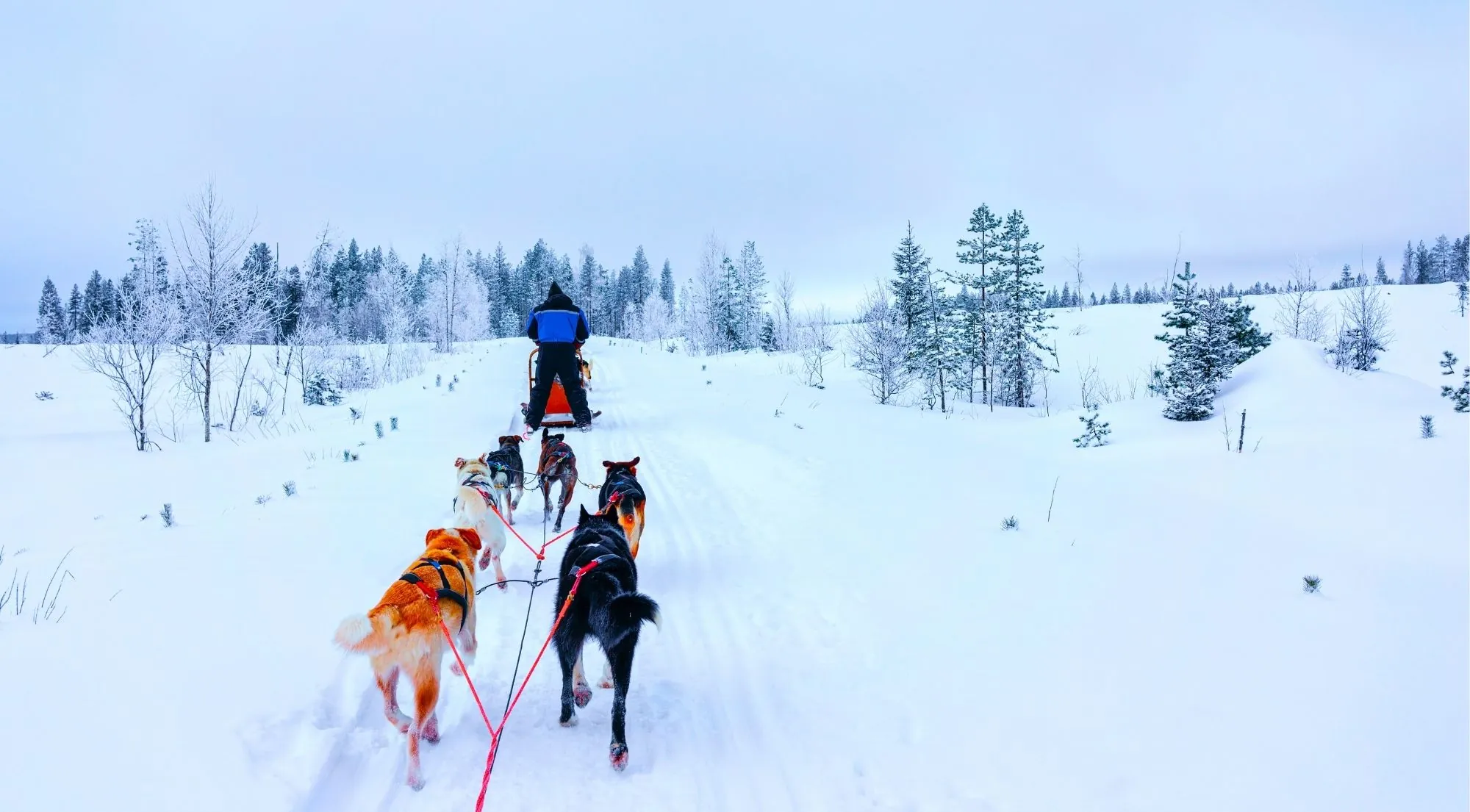
- behind a team of huskies
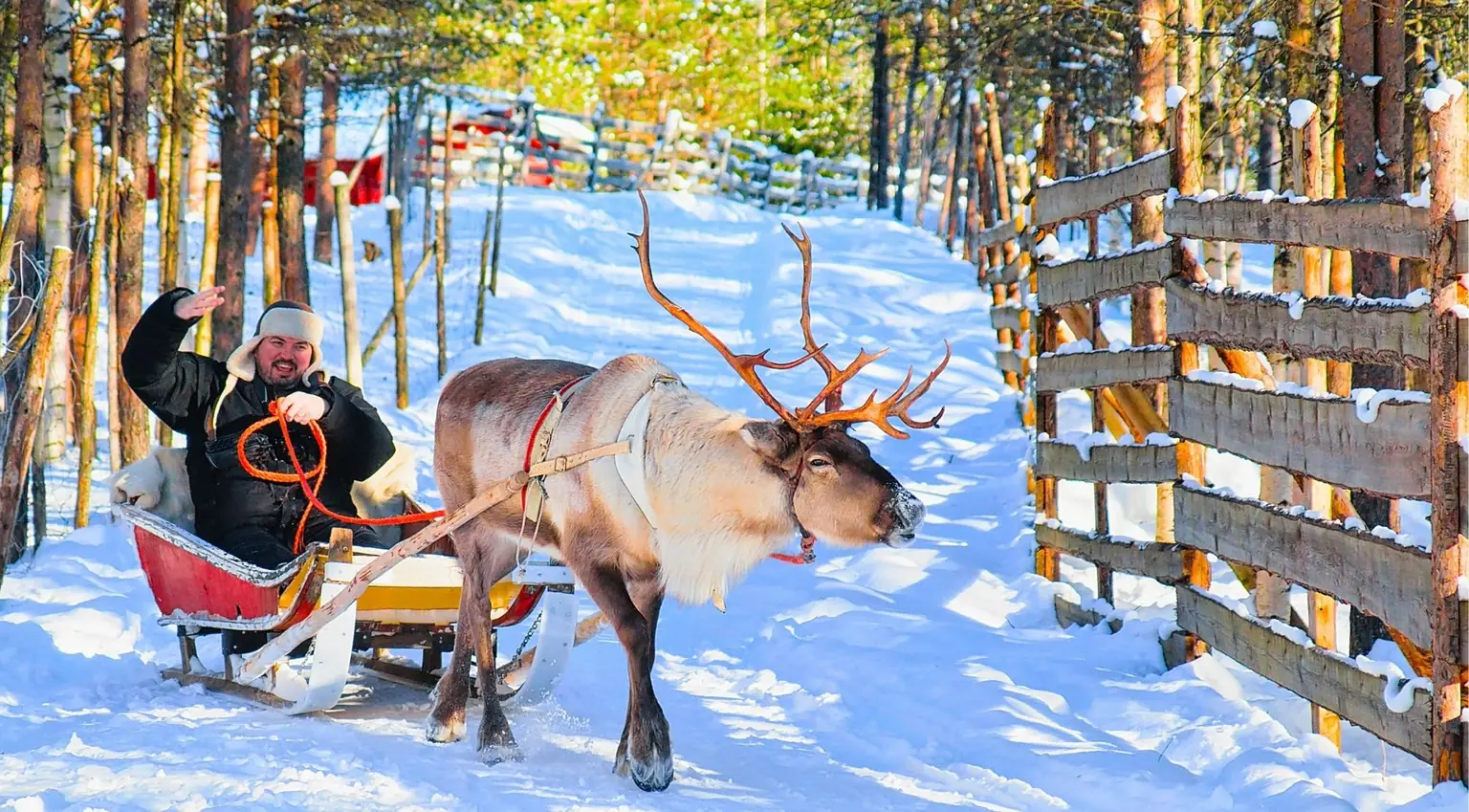
- from a reindeer sleigh
- beside a wilderness campfire
- from a glass-roofed cabin
- with a professional photographer
- or on long-distance aurora chases that may travel hundreds of kilometres looking for clear skies
There is no single “best Northern Lights tour.” The right one depends on whether your priority is maximising your chance of seeing the aurora or having a memorable Lapland experience even if the aurora never appears.
That distinction is more important than almost anything else when booking.
The best Northern Lights tours in Lapland: which type should you choose?
1. Mobile aurora chase by minibus
Best for: maximising your chances
If the Northern Lights are one of the main reasons you are travelling to Lapland, this is generally the type of tour we would choose.
A proper aurora chase does not simply drive 20 minutes from Rovaniemi to a fixed camp and wait.
Instead, the guides monitor:
- cloud forecasts
- satellite imagery
- local weather
- road conditions
- geomagnetic activity
- visibility at different locations
and change the route accordingly.
Some operators may drive considerable distances when necessary.
For example, one currently advertised Rovaniemi tour allows up to eight hours and potentially hundreds of kilometres of driving, including the possibility of travelling towards Sweden if that is where the clearer sky is.
That does not mean longer is automatically better. But when cloud cover varies across Lapland, mobility is a genuine advantage.
Pros
- Best ability to escape local cloud
- Usually visits several viewing locations
- Comfortable between stops
- Good option in very cold weather
- Often includes photography
- Works particularly well from Rovaniemi
Cons
- Less romantic than reindeer or snowmobile experiences
- You may spend a lot of time driving
- Late returns are possible
- Young children may become tired
Our take
Choose this if seeing the Northern Lights matters more to you than how you get there.
Our pick: Rovaniemi: Northern Lights Tour – 100% Guarantee & Photos, a small-group hunt that follows live weather data and drives up to 200 km to find clear sky, with a refund if no aurora is captured (4.8/5 from more than 2,700 reviews, from €109).
2. Small-group Northern Lights photography tour
Best for: couples, photographers and people who want good pictures
These tours combine aurora hunting with help photographing the sky.
A good photography tour normally includes:
- a small group
- transport away from city lights
- a guide familiar with night photography
- tripod assistance
- camera-setting advice
- photographs taken of you beneath the aurora
- digital images sent after the tour
Some provide thermal clothing too.
For example, one current Rovaniemi photography tour includes a maximum of eight guests per guide, winter boots and clothing, tripods and edited photographs. Its advertised starting price is €145 per person.
Another current tour includes winter clothing, photography and transport between multiple viewing locations, with prices starting around €115.
Why photography matters more than you might expect
Northern Lights often appear stronger in photographs than to the naked eye.
Modern cameras and phones can collect light over several seconds, revealing colour that human eyes may perceive as pale green or even grey.
Do not interpret that as meaning the real aurora is disappointing.
A strong display can be spectacularly obvious to the naked eye. But photographs on tour websites often represent what the camera records rather than exactly what your eyes will see.
Our take
For most couples visiting Lapland for the first time, a small-group photography chase is one of the best all-round choices.
Our pick: Rovaniemi: Aurora Hunt – Free Photos, 100% Guaranteed, a small-group hunt with local guides who follow the live forecast, with free photos of you under the lights (4.8/5 from more than 1,300 reviews, from €76).
3. Northern Lights camp experience
Best for: atmosphere rather than maximum mobility
Instead of chasing clear weather over a large area, these excursions usually transport you to a wilderness location away from Rovaniemi or another resort.
You might find:
- an open fire
- hot berry juice
- sausages or snacks
- a traditional kota shelter
- frozen lake views
- stories about Lapland
- aurora photography
You wait and watch the sky.
This can be a wonderful Arctic evening even if the Northern Lights remain stubbornly absent.
The disadvantage is obvious: the camp cannot move when the clouds move in.
Some camp experiences operate regardless of cloud conditions and explicitly state that the focus changes to experiencing Arctic nature when the aurora cannot be seen.
Our take
Choose this when your attitude is:
“I’d love to see the Northern Lights, but we’d also like a beautiful Lapland evening even if we don’t.”
If your attitude is:
“I have travelled to Finland primarily to see the aurora.”
book a mobile chase instead.
4. Reindeer sleigh Northern Lights tour
Best for: romance and classic Lapland atmosphere
Few experiences look more unmistakably Lapland than sitting beneath reindeer hides while a sleigh moves quietly through a snowy forest.
These excursions commonly combine:
- visiting a reindeer farm
- meeting or feeding reindeer
- a sleigh ride
- a campfire
- Finnish snacks
- Northern Lights watching
A current Rovaniemi reindeer-and-aurora experience, for example, lasts about three hours, includes transfers, snacks and approximately 25 minutes travelling by reindeer sleigh, with prices starting at €169.
The trade-off is that a reindeer cannot chase breaks in cloud cover over 100 kilometres.
Think of the aurora as the possible grand finale. The activity is not designed to find it at all costs.
Best for
- couples
- honeymoon trips
- families
- first visits to Lapland
- travellers prioritising atmosphere
Less suitable for
- dedicated aurora hunters
- travellers with only one possible viewing night
See our reindeer tours in Rovaniemi for the daytime and evening sleigh rides on offer.
5. Snowmobile Northern Lights tour
Best for: adventure
This combines two classic Lapland experiences into one evening.
You travel along forest trails after dark, away from urban lighting, before stopping somewhere with an open view of the sky.
Some tours include:
- thermal overalls
- helmets
- hot drinks
- campfires
- photography
- wilderness stops
A current Rovaniemi snowmobile aurora safari, for example, lasts around two hours including preparation, with roughly 1 hour 40 minutes of riding. Its operator clearly notes that neither the appearance nor colour of the Northern Lights can be guaranteed.
The downside
A snowmobile safari follows trails rather than cloud forecasts.
If the main objective is seeing the aurora, a vehicle-based chase has much more freedom.
Our take
Book a snowmobile tour because you want to snowmobile at night. Treat any Northern Lights as a spectacular bonus. Our snowmobile safaris page compares the Rovaniemi options.
6. Glass igloo or aurora cabin
Best for: comfort
Sleeping beneath a glass roof sounds like the easiest Northern Lights experience of all.
Sometimes it is.
You can potentially watch the sky without:
- putting boots on
- boarding a bus
- standing outside at -20°C
- returning to the hotel at 2am
But there is an important limitation.
An aurora cabin cannot move.
If your resort is underneath cloud while the sky 80 kilometres away is clear, your expensive glass ceiling will show you an excellent view of the clouds.
Glass cabins are therefore fantastic accommodation, but we would not automatically substitute one for an aurora chase.
If seeing the Northern Lights is crucial, combine the two.
For the glass-roof experience without booking a night, Rovaniemi: Aurora Igloo Private Lappish Dinner Experience serves a three-course dinner of local ingredients in a glass igloo dome in the forest (4.8/5 from 42 reviews, from €145).
Northern Lights tour comparison
| Tour type | Aurora-finding ability | Experience | Typical duration | Best for |
|---|---|---|---|---|
| Mobile minibus chase | ★★★★★ | ★★★★☆ | 3–8+ hours | Best chance |
| Photography tour | ★★★★★ | ★★★★★ | 3–5+ hours | Couples, photos |
| Wilderness camp | ★★☆☆☆ | ★★★★★ | 2.5–4 hours | Atmosphere |
| Reindeer sleigh | ★★☆☆☆ | ★★★★★ | 2.5–4 hours | Families, couples |
| Snowmobile safari | ★★☆☆☆ | ★★★★★ | 2–4 hours | Adventure |
| Glass cabin | ★☆☆☆☆ | ★★★★★ | Overnight | Comfort |
Important: these ratings refer to the tour’s ability to react to changing weather, not the probability that auroras will occur.
Where is the best place for Northern Lights tours in Lapland?
The simple rule is:
the farther north you go, the better the statistical odds become.
The Finnish Meteorological Institute estimates that on a dark, cloudless night, auroras are visible approximately:
| Area | Approximate probability on a dark, clear night |
|---|---|
| Kilpisjärvi | 75% |
| Lapland resorts including Levi, Ylläs and Saariselkä | ~50% |
| Central Finland around Oulu/Kuusamo | ~25% |
| Southern coast | Roughly once per month |
These are long-term statistics, not a forecast for your specific holiday. Our guide to the best places to see the Northern Lights in Lapland compares each area in more depth.
Rovaniemi
Best all-round choice for first-time visitors
Rovaniemi is the easiest place to combine the Northern Lights with:
- Santa Claus Village
- reindeer farms
- husky sledding
- snowmobiling
- family attractions
- restaurants
- hotels
- direct transport connections
Auroras can generally be seen around Rovaniemi from late August to early April.
Its other advantage is competition.
There are many aurora operators, which gives you a choice between inexpensive bus tours, small-group photography trips, wilderness camps and serious long-distance chases.
Choose Rovaniemi for: convenience and variety.
Saariselkä and Ivalo
Go considerably farther north and the odds improve.
The area around Saariselkä and Ivalo offers:
- darker surroundings
- less urban light pollution
- wilderness immediately outside the resorts
- excellent winter activities
- a strong range of aurora accommodation
Choose Saariselkä/Ivalo for: a more aurora-focused holiday without giving up resort infrastructure.
Inari
Inari is even quieter and feels considerably more remote.
Large open lakes and sparse settlement provide excellent horizons and very dark skies.
It is particularly appealing if you want your trip to focus on:
- Arctic wilderness
- Sámi culture
- photography
- aurora watching
rather than Santa attractions.
Levi
Levi works especially well if you want to combine Northern Lights excursions with skiing.
It has plenty of tourism infrastructure and aurora tours while still being significantly farther north than Rovaniemi.
Choose Levi for: skiing + Lapland activities + Northern Lights.
Ylläs
Ylläs offers a quieter fell-and-forest atmosphere and access to extensive wilderness.
It is a good compromise for visitors wanting plenty to do without staying in a city.
Kilpisjärvi
Best for serious aurora hunters
Kilpisjärvi sits in the far northwest of Finland close to Norway and Sweden.
According to Finnish Meteorological Institute statistics, auroras are visible there on roughly three out of four dark, cloud-free nights.
The trade-off is accessibility and a much smaller tourism infrastructure.
Choose Kilpisjärvi if seeing the Northern Lights takes priority over almost everything else.
When is the best time for Northern Lights tours in Lapland?
The short answer
Go between:
September and March
with particularly good periods around:
September–October and February–March.
Finland’s official tourism organisation identifies late August to early April as the overall aurora season, with September–October and February–March among the strongest periods. Our month-by-month guide to the best time to see the Northern Lights goes through each month in detail.
Northern Lights in Lapland month by month
| Month | Aurora viewing | Snow | What it’s like |
|---|---|---|---|
| Late August | Possible | Usually no | First dark nights |
| September | Excellent | Usually little/no snow | Strong aurora season |
| October | Excellent | Increasing chance | Dark nights, quieter |
| November | Very good | Usually arriving | Early winter |
| December | Very good | Excellent | Christmas atmosphere, busiest |
| January | Very good | Excellent | Deep winter, very cold |
| February | Excellent | Excellent | Great balance |
| March | Excellent | Excellent | Our favourite all-round period |
| Early April | Possible-good | Usually plentiful | Brighter evenings |
September
One of the most underrated times to hunt auroras.
Before the lakes freeze, calm water can reflect the Northern Lights and create the famous double aurora effect.
There is generally less Christmas tourism too.
December
This is what many visitors imagine when they picture Lapland:
snowy forests + Santa + reindeer + polar darkness + Northern Lights.
It is magical.
It is also one of the busiest and most expensive periods.
Come in December because you want the complete Christmas Lapland experience — not because it necessarily gives you uniquely better aurora odds.
January
January brings extraordinarily long periods of darkness and deep winter landscapes.
It can also be brutally cold.
The reward is an abundance of hours during which an aurora could potentially be visible.
February
February is an excellent compromise.
You still get:
- reliable winter scenery
- long dark evenings
- abundant snow
- excellent husky and snowmobile conditions
while the Christmas crowds have disappeared.
March
If we were planning a trip primarily around Northern Lights + snow + outdoor activities, March would be one of our first choices.
The Finnish Meteorological Institute says that, taking weather into account, March and early April are particularly favourable for aurora watching in northern Finland.
You also gain longer daylight hours for daytime activities.
What time do Northern Lights tours start?
Most depart in the evening.
The Finnish Meteorological Institute identifies roughly 9pm–1am as the most favourable part of the night statistically, while Visit Finland gives a typical prime window extending roughly from 9pm until 2am.
Do not treat 9pm as an appointment with the aurora.
They can appear earlier or later whenever conditions allow.
Longer aurora chases therefore sometimes keep their schedule deliberately flexible.
How much do Northern Lights tours in Lapland cost?
Prices change by season and operator, but current Rovaniemi listings illustrate the broad range well.
Examples include:
- basic minibus aurora tour — from around €89
- longer mobile chase — around €109+
- photography tour — around €110–€190
- reindeer Northern Lights experience — around €169
- specialist long-distance/guarantee-style chase — around €199+
- premium/private experiences — considerably more
Current examples on the official Visit Rovaniemi marketplace range from €69 for some basic aurora hunts to around €199 for specialised small-group chases, before moving into much higher private-tour prices.
Treat these as indicative prices, not fixed tariffs. Our Rovaniemi Northern Lights tour prices guide breaks them down by type of tour.
Christmas and New Year dates can be especially expensive.
Is a more expensive Northern Lights tour worth it?
Sometimes.
What you are often paying extra for is not a better aurora.
You are paying for:
- smaller groups
- longer driving range
- better vehicles
- professional photography
- thermal clothing
- experienced guides
- flexible departure times
- hotel pickup
- fewer fixed schedules
We would pay more for mobility and guide quality.
We would not automatically pay more for decorative extras such as elaborate dinners if seeing the aurora is the main objective.
Can a Northern Lights tour guarantee the aurora?
No operator can make the Northern Lights appear.
Aurora visibility depends on several conditions that tour companies do not control, particularly:
- geomagnetic activity
- darkness
- cloud cover
The Northern Lights are a natural phenomenon.
Visit Finland and many Rovaniemi operators explicitly point out that sightings cannot be promised.
So what does a “guaranteed Northern Lights tour” actually mean?
Always read the terms.
Depending on the operator, “guaranteed” might mean:
- the company drives much farther in search of clear skies
- you can repeat the tour
- you receive another attempt at a discount
- you receive some form of refund
It does not mean the guide has discovered a way to switch on the aurora.
The most important thing to check before booking
Ask:
“Does this tour actively chase clear skies?”
That one question tells you more than whether the excursion includes marshmallows, berry juice or sausages.
Cloud is often the biggest enemy.
The Finnish Meteorological Institute notes that auroras may be common in Lapland, but viewing statistics assume dark and cloudless conditions.
A driver who can travel toward a break in the cloud can therefore be more valuable than a theoretically high aurora forecast.
Don’t obsess over the Kp index
You will frequently see travellers checking the global Kp index.
It is useful, but don’t make the mistake of assuming:
low Kp = no Northern Lights in Lapland.
Northern Finland lies close enough to the auroral zone that relatively modest geomagnetic activity can still produce visible auroras.
The Finnish Meteorological Institute maintains its own near-real-time monitoring system based on magnetic measurements at Finnish stations. When activity crosses location-specific thresholds, its display indicates increased aurora probability.
For Lapland, we would check:
- local cloud forecast
- Finnish Meteorological Institute aurora information
- real-time magnetic activity
- your guide’s local assessment
rather than relying on a single app displaying one global number.
How many nights should you stay in Lapland to see the Northern Lights?
At least three nights is much safer than one.
Four or five is better if the aurora is a major reason for your journey.
Even excellent aurora destinations can experience several consecutive cloudy nights.
Think in probabilities. Nothing here is guaranteed.
If you stay only one night, you get one weather system.
If you stay several nights, you get several chances.
Which night should you book your tour?
Book the aurora tour near the beginning of your trip.
This is one of the simplest useful pieces of advice.
If you’re staying five nights, don’t schedule your only tour for night five.
Booking it on night one or two leaves room to:
- rebook
- take a second excursion
- watch independently
- use a repeat-tour policy
if the first evening is cloudy.
Some operators explicitly recommend booking early for exactly this reason.
What happens on a Northern Lights tour if there are no Northern Lights?
This varies enormously.
You might:
- visit several viewing locations
- sit beside a campfire
- photograph stars
- eat snacks
- hear stories about the aurora
- learn about Arctic nature
- return early
- continue driving for hours
- receive a discounted second attempt
- receive another tour under the operator’s guarantee policy
Read the cancellation and no-aurora terms before paying.
What should you wear?
Standing still under a clear Arctic sky feels much colder than walking around Rovaniemi during the day.
Visit Finland recommends dressing carefully because clear winter nights can be well below freezing, while Visit Rovaniemi recommends layering thermal underwear beneath insulating wool or fleece and protective outer clothing.
A good setup is:
- thermal base layer
- wool or fleece mid-layer
- insulated winter jacket
- insulated trousers
- warm wool socks
- properly insulated winter boots
- hat covering your ears
- warm gloves or mittens
- neck warmer
Boots matter enormously
Cold feet ruin aurora tours faster than almost anything.
Avoid squeezing multiple thick socks into tight footwear. Restricted circulation can make your feet colder.
Some premium tours include Arctic overalls and boots.
Others provide nothing.
Check before booking. Our Lapland winter packing guide has the full list of what to bring.
Are Northern Lights tours suitable for children?
Yes, but choose carefully.
A three-hour camp or reindeer experience can work brilliantly for families.
An eight-hour mobile chase returning after midnight is another story.
For younger children look for:
- thermal clothing included
- short transfers
- toilets or heated shelter
- predictable duration
- snacks
- earlier departure
- simple walking conditions
One current Rovaniemi photography operator specifically advises parents to consider whether late-night timing is appropriate for small children.
For families, the best aurora tour mathematically may not be the best aurora tour practically. Our guide to Rovaniemi with kids has more family planning tips.
Are Northern Lights tours suitable for older travellers?
Many are.
A minibus tour usually requires relatively little physical activity.
Check:
- distance walked on snow
- icy terrain
- toilet availability
- vehicle access
- steps
- how long you will stand outside
If mobility is limited, avoid assuming every “easy” wilderness excursion is accessible.
Winter paths can be snowy and uneven.
Can you see the Northern Lights without a tour?
Absolutely.
The aurora does not charge admission.
If you have:
- a clear night
- darkness
- a safe location
- an open horizon
- little artificial light
you can watch independently.
The Finnish Meteorological Institute recommends finding a dark, open location away from town lights, ideally with an unrestricted view toward the northern sky.
Why take a tour at all?
A tour provides three things that independent visitors may lack:
1. Mobility
Guides can move when cloud cover changes.
2. Local knowledge
They know accessible lakes, forests, roads and viewing locations.
3. Arctic safety
Finding an isolated dark location sounds simple until you are dealing with snow-covered roads, -25°C temperatures and unfamiliar terrain at midnight.
For a first visit, we generally think one guided chase is worth booking.
After that, you can watch independently on additional nights.
Can you see the Northern Lights from Rovaniemi city centre?
Sometimes.
Strong auroras can certainly be visible from the city.
But street lighting reduces contrast.
You will usually see more detail once you move away from artificial lights. Visit Finland specifically recommends open locations outside bright urban areas, such as lakeshores and hills.
You do not necessarily need to travel for hours.
The important thing is finding:
- darkness
- clear sky
- a wide horizon
Do Northern Lights really look like the photos?
Sometimes.
But not always.
During strong activity you may see bright green curtains visibly moving across the sky.
During weaker displays the aurora might initially resemble:
- pale cloud
- a grey-white band
- faint green haze
Point your phone at it in night mode and suddenly it may appear bright green.
This difference exists because cameras can gather more light than your eyes over longer exposures.
Keep expectations realistic and you are less likely to spend the evening wondering why the sky does not resemble a heavily edited Instagram photograph.
How long do Northern Lights last?
There is no fixed duration.
A display might last:
- only minutes
- come and go repeatedly
- remain faint for hours
- suddenly intensify into fast-moving curtains
Visit Finland notes that displays can last anywhere from a few minutes to several hours.
That unpredictability is part of the experience.
Northern Lights photography: simple phone settings
Modern phones are surprisingly capable.
For the best results:
- activate Night Mode
- hold the phone completely still
- use a tripod if possible
- avoid digital zoom
- turn the flash off
- include trees, people or cabins for scale
If Night Mode allows you to choose exposure length, longer exposures help with faint auroras, while shorter exposures preserve detail when the lights are moving rapidly.
Camera settings for Northern Lights
A useful starting point for a mirrorless or DSLR camera is:
- manual mode
- aperture around f/1.4–f/2.8
- ISO around 800–3200
- shutter around 1–8 seconds
- manual focus at infinity, then fine-tune on a star
These are starting points, not rules.
Fast-moving bright auroras require shorter exposures.
Faint auroras may need longer ones.
A tripod makes an enormous difference.
Should you book one or two Northern Lights tours?
For most people:
one good tour + several independent nights is enough.
Consider two tours if:
- the aurora is your main reason for travelling
- your first attempt fails
- you want two different experiences
For example:
Night 1: serious minibus aurora chase
Night 3: reindeer or snowmobile experience
That makes more sense than booking three near-identical bus tours before you even arrive.
How to choose a Northern Lights tour
Before booking, check these ten things.
1. Is it a chase or a fixed-location experience?
This is the biggest distinction.
2. What is the maximum group size?
Smaller groups tend to move faster and provide more individual photography help.
3. How far will they drive?
A 20-kilometre excursion and a 300-kilometre chase are fundamentally different products.
4. How long can the tour run?
Flexible end times are useful when chasing weather.
5. Is winter clothing included?
Especially important in January and February.
6. Are photographs included?
Professional portraits beneath the aurora can be worth paying for.
7. What happens when the forecast is poor?
Some operators cancel.
Others run regardless.
Neither policy is automatically wrong — but you should know which one you are buying.
8. What does “guaranteed” actually mean?
Read the small print.
9. Is hotel pickup included?
Remote accommodation may attract extra fees.
10. What is the cancellation policy?
Winter weather and changing travel plans make flexibility valuable.
A useful rule when comparing tours
If seeing the aurora is the priority:
Choose:
small-group mobile chase + long driving range + photography + flexible schedule
If the Lapland experience is the priority:
Choose:
reindeer / snowmobile / wilderness camp
If comfort is the priority:
Choose:
glass cabin + optional guided chase
If travelling with young children:
Choose:
shorter tour + warm shelter + thermal clothing
Our ideal Northern Lights plan for a first Lapland trip
If we had four nights in Rovaniemi, we would do this:
Night 1
Book a serious mobile aurora chase.
Night 2
Keep free for independent viewing.
Night 3
Book a reindeer or snowmobile evening because the activity itself is worthwhile.
Night 4
Keep flexible.
If the first three nights have been cloudy, this becomes your emergency second chase.
That gives you several opportunities without turning your entire Lapland holiday into hours sitting in minibuses.
Frequently asked questions
What is the best month to see the Northern Lights in Lapland?
September–October and February–March are particularly strong periods. February and March are excellent choices if you also want deep snow and winter activities.
Is December good for Northern Lights in Lapland?
Yes. December has very long periods of darkness and excellent winter scenery, although Christmas is also one of Lapland’s busiest travel periods.
Is January good for Northern Lights?
Yes. January offers long nights and reliably wintry landscapes but can be extremely cold.
Can you see Northern Lights every night in Lapland?
No. Auroras occur frequently, but cloud cover and geomagnetic conditions vary. In much of Lapland, FMI statistics suggest auroras are visible on roughly every second dark, cloudless night.
What is the best time of night?
Around 9pm–1am is statistically favourable, although auroras can appear whenever the sky is sufficiently dark.
Where are your chances highest in Finland?
Far northern Lapland. FMI gives Kilpisjärvi an approximate 75% viewing probability on dark, cloud-free nights.
Is Rovaniemi good for Northern Lights?
Yes. It combines regular aurora opportunities with Finland’s largest range of Lapland tourism infrastructure and excursions.
Do you need a Northern Lights tour?
No. But for first-time visitors, a good mobile tour improves your ability to escape city light and local cloud.
Are Northern Lights tours worth it?
They are most worthwhile when the operator is genuinely using local weather knowledge and mobility to improve your chances. A fixed camp is better considered an Arctic evening experience with possible aurora viewing.
Can tour operators guarantee Northern Lights?
They cannot guarantee the natural phenomenon. Check what any commercial “guarantee” actually covers.
How many nights should I stay?
Three nights is a reasonable minimum if seeing the aurora matters. Four or five provides a useful buffer against cloudy weather.
Northern Lights tours in Lapland: the bottom line
Seeing the Northern Lights is one of those travel experiences where spending more money does not make nature more cooperative.
The best strategy is surprisingly simple:
go north, stay several nights, find dark skies and remain flexible.
For most first-time visitors, we would spend the money on one genuinely mobile small-group aurora chase, preferably near the beginning of the holiday.
Then leave several other evenings free.
If the sky clears above your cabin on night three, step outside.
You do not need a guide, an igloo or a snowmobile once the aurora is dancing above you.
You just need to look up.